
Four different energy strategies for hotels, restaurants, cafeterias, and fast food
On this page
Energy consumption plays a significant role in both cost control and the sustainability of your hospitality business. Hotels, restaurants, cafeterias, and snack bars consume a lot of energy due to the need for heating, cooling, lighting, and kitchen equipment to optimally serve guests. With rising energy prices and stricter regulations, managing energy efficiently is more important than ever.
In this article, we discuss four practical strategies to reduce energy consumption, increase operational efficiency, and promote sustainability. Whether you run a hotel, restaurant, cafeteria, or snack bar, a well-thought-out energy strategy is essential for a future-proof business.
A well-considered energy strategy not only helps hospitality businesses lower operational costs but also strengthens their sustainability goals and ensures compliance with laws and regulations such as the energy-savings obligation. Moreover, it offers a significant competitive advantage by operating more efficiently and implementing cost savings where possible.
Rising energy costs and limited growth
The energy crisis has had a major impact on the profitability of Dutch hospitality businesses. The Netherlands is heavily dependent on gas, and gas prices here are higher than the EU average. This is partly due to limitations in gas supply from Russia and geopolitical developments. Although steps are being taken to become less dependent on Russian gas, the energy market remains unpredictable and volatile.
Additionally, hospitality businesses deal with an overloaded power grid, which increases the likelihood of power interruptions. This can disrupt service and negatively affect quality and customer satisfaction. The overload of the network will also impact energy costs.
Major impact energy crisis on profitability Dutch companies – Energy and Utilities – Services and Industries – Insights and Publications – PwC
Despite signs of revenue recovery, growth remains modest. The high energy costs continue to weigh heavily on profit margins, contributing to a negative business sentiment in the Dutch hospitality sector.
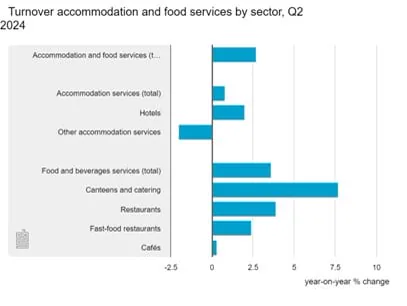
In the second quarter of 2024, revenue in the Dutch accommodation and food services sector increased by 2.7 percent compared to the same period in 2023 , according to the Central Bureau of Statistics (CBS). Accommodation services saw modest growth of 0.8 percent, while revenue in food and beverage services increased by 3.6 percent.
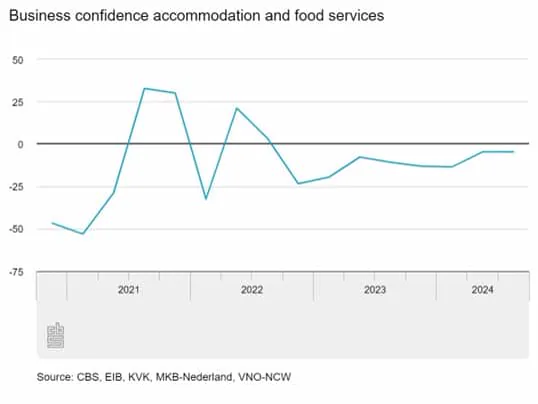
The CBS also monitors business confidence in this sector . At the start of the third quarter of 2024, business confidence was slightly more negative than at the start of the second quarter, with a score of -4.7 compared to -4.6. Although businesses were slightly more positive about the past three months, they were more concerned about economic prospects for the coming three months. Confidence in most sectors in the Netherlands improved at the beginning of Q2, but remained negative in many cases.
Almost half of the entrepreneurs in the accommodation and food services sector ended the first half of 2024 with a profit. In comparison, 65 percent of Dutch businesses across all economic sectors closed the first half of the year with a profit. Only the culture, sports, and recreation sectors and retail performed worse than the accommodation and food services sector.
Pressure to meet sustainability requirements and regulations
The Dutch hospitality sector is increasingly under pressure to adopt sustainable measures. This is driven not only by consumers who demand environmentally friendly choices but also by stricter laws and regulations and the need to maintain a positive brand reputation. Many hospitality businesses, however, face organizational challenges. Changes in operational processes and staff training are often necessary, complicating the implementation of sustainable solutions.
Moreover, issues such as network congestion and rising transportation costs make the transition to renewable energy sources and sustainable logistics challenging. The high investment costs of sustainable technologies pose a barrier especially for businesses with low profit margins. Effectively managing complex strategies, such as flexible energy demand, is also a challenge for many entrepreneurs. The diversity within the hospitality sector makes it difficult to find one universal solution that works for everyone.
Although the sector saw a revenue growth of 2.7% in Q2 2024, less than half of the businesses are profitable and business confidence is negative. This causes many hospitality businesses to struggle to prioritize sustainability initiatives over their immediate financial concerns.
Impact on hospitality:
The energy challenges facing hospitality businesses have direct consequences on multiple fronts:
Operational disruptions
Energy outages or inefficient systems cause downtime and delays that slow down service, hurt the guest experience, and can damage your reputation.
Financial pressure
Inefficient energy use drives up costs, squeezing already tight profit margins in a competitive market.
Compliance risks
Failing to meet energy and environmental regulations risks fines and legal claims, and can block certifications customers increasingly expect.
A restaurant that regularly experiences power outages risks food spoilage and malfunctions in kitchen equipment. This not only leads to operational delays but also potential damage to equipment, resulting in higher maintenance or replacement costs.
The role of Energy Portfolio Management in addressing these challenges:
Energy portfolio management offers a strategic and integrated approach to optimizing energy consumption and contracts. Key components include:
Energy procurement
Buying energy strategically from reliable suppliers optimizes costs and secures supply.
Demand management
Understanding your consumption patterns keeps usage within contracted power limits, even at peak hours.
Risk management
Analyzing your risk profile points to energy solutions that are affordable and realistic for your business.
Sustainability
Blending renewable sources and energy-efficient technology into your energy mix moves the business forward.
What does Energy Portfolio Management mean for the hospitality sector?
Cost control
Optimizing energy purchasing and consumption can lower your energy costs.
Risk mitigation
A well-managed energy portfolio helps protect against price volatility and supports a reliable supply.
Regulatory compliance
Proactive energy management keeps you ahead of changing energy law, including the energy-savings obligation.
Brand influence
A strong sustainability focus attracts environmentally conscious guests and business partners.
Above 50,000 kWh of electricity or 25,000 m³ of gas a year, Dutch law requires every energy-saving measure that pays for itself within five years.

Practical applications
Here is a step-by-step guide to effectively implementing energy portfolio management in a hospitality venue:
- 1
Conduct an energy audit
Analyze current energy consumption to identify areas for improvement and address inefficiencies.
- 2
Set clear goals
Formulate specific and measurable goals for energy savings and cost reduction.
- 3
Diversify energy sources
Combine grid electricity with local renewable sources and storage for more flexibility and lower costs.
- 4
Implement an energy management system
Use smart technologies to monitor and control energy consumption in real time.
- 5
Train staff
Make sure employees know energy-saving practices and their role in reaching your energy goals.
- 6
Evaluate and optimize regularly
Keep monitoring energy performance and adjust where needed for maximum results.
Short-term
What changes fast once inefficiencies are addressed.
- Immediate cost savings on one of hospitality's largest operating expenses
- Improved operational efficiency, day to day
- Enhanced guest comfort from a stable, well-run environment
Long-term
What compounds as the strategy matures.
- Increased sustainability, positioning the business as environmentally conscious
- Compliance with the energy-savings obligation before it's enforced
- Improved market positioning as customers pay more for responsible businesses
- Increased resilience against price swings and grid disruptions
Competitive advantage
What sets the business apart from the rest of the market.
- Room to offer competitive prices without cutting into service
- A pull for environmentally conscious guests and business customers
- Leadership in sustainability, in a sector driven by reviews and reputation
Implement strategies
Hotels
Smart building technology, automated lighting, climate control, and on-site renewables, cuts costs while protecting guest comfort and the hotel's image.
- Automated climate control that adjusts to occupancy and weather
- Load shifting via energy storage to off-peak hours
- Solar panels on roofs or parking lots
- Heat recovery from laundry and kitchens, reused for water or space heating
Restaurants
Energy-efficient kitchen equipment and waste-to-energy programs cut costs and meet the sustainability expectations increasingly shaping where guests choose to eat.
- High-efficiency fridges, ovens and dishwashers
- Demand-controlled ventilation tied to cooking activity
- Induction cooktops instead of gas or electric
- Food waste converted to biogas for heating or power
Cafeterias & snack bars
With tighter budgets, simple demand-management wins, smarter HVAC use, more daylight, cut bills while keeping the atmosphere inviting.
- Smart meters for real-time consumption insight
- Energy-efficient service equipment with smart controls
- Battery storage to shift usage away from peak hours
- Demand-response participation, paid for reducing draw at peak times
Large event venues
Smart energy management and dynamic pricing keep highly variable demand under control, protecting supply during events and reducing peak costs.
- Lighting, heating and cooling tied to occupancy and event schedules
- Sensors to monitor consumption area by area and flag savings
- Dynamic pricing agreements to benefit from off-peak rates
In summary, each of these strategies plays a crucial role in lowering costs, reducing CO2 emissions, limiting the impact of network congestion, and improving overall operational resilience. For example, an analysis and control platform such as Energy Intelligence can help a hotel or restaurant reduce unnecessary energy consumption during off-peak hours and limit peak load.
Conclusion
Key points:
- Energy portfolio management is no longer a luxury but a necessity for hospitality businesses that want to thrive in an increasingly complex energy landscape. By implementing tailor-made strategies for hotels, restaurants, and cafeterias, businesses can realize significant cost savings, enhance their sustainability profile, and gain a competitive advantage.
- Effective energy management strategies tailored to specific hospitality businesses can lead to significant cost savings, improved sustainability, and enhanced market positioning.
- Futureproof : As the hospitality sector continues to evolve, it will be crucial to stay ahead with innovative energy strategies for long-term and futureproof success.
- We encourage all hospitality businesses and managers to take the first step by conducting an energy audit of their operations. This will provide the baseline data needed to develop a comprehensive energy management strategy for monitoring, insight and optimalisation .
- Most Dutch hospitality businesses are l egally required to implement certain energy-saving measures under the energy-savings obligation if the investement can be recouped within five years if their annual consumption exceeds 50,000 kWh or 25,000 m³ of gas. In addition to lowering future energy costs, this also reduces the risk of fines or sanctions.



Does this apply to your business?
Our energy specialists are happy to look at what this means for your connections, your contract and your purchasing situation. Without obligation.