
COMCAM
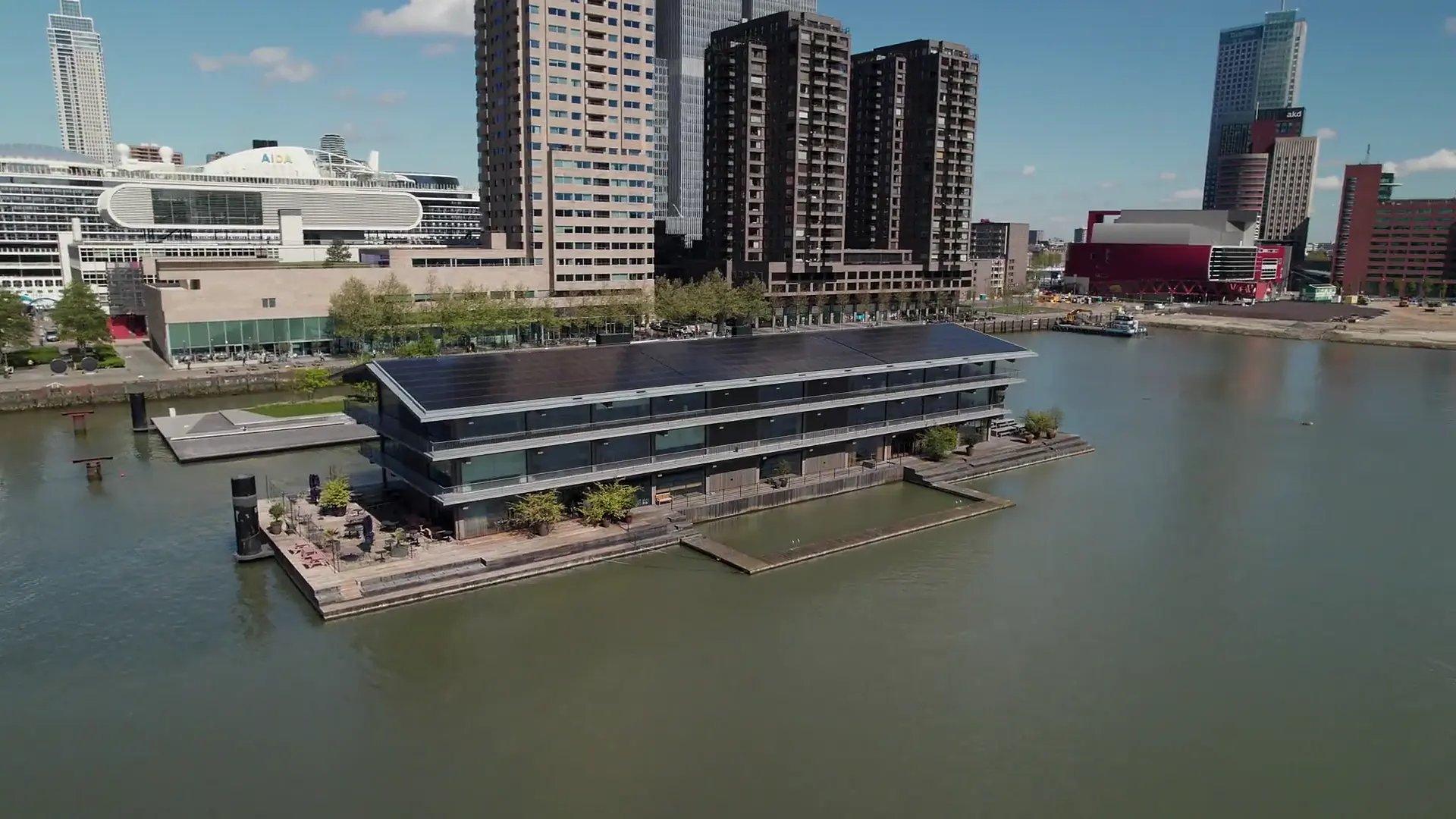
A floating office building with a solar-panelled roof, moored in a city harbour with the skyline behind it
The portfolio is already standing

Real estate

For an asset or property manager this stopped being a sustainability question some time ago. It is about which objects still let, which of them miss a label date, and how much contracted capacity you pay for every month and cannot prove you need.

COMCAM manages that as one position across the whole portfolio, with the quarter-hour data behind it, so a decision per object stops being a guess.

office16 °C8 °Crooftop solaraquifer storecharging plazagridAn office day in kWpeak avoidedspread chargingsolar outputresidentialoffice usekWcharge00:0006:0012:0018:0024:00Illustrative daily profile, schematic, not measured dataoffice 08:00-18:00office drop (18:00)combined peakcharge spread plateau
The force field

Three forces that pull on every energy decision

We see the same pattern in every sector. A market that keeps moving, what your connection and your own profile allow, and where sustainability has to take you. Each on its own is manageable. The bigger problems arise where they overlap, and that is where most of our work is.

Market volatilityGrid capacityand own profileSustainability

Choose an area in the diagram

All three at once

Owner, tenants and grid in one energy plan per property and per portfolio: the only way decarbonisation stays affordable and feasible.

How COMCAM helps

One portfolio, one team: analysis, strategy, trading and risk management across all three forces.

Portfolio reality

Your 2030 position is already built

With only a fraction of utility buildings being newly built each year against a standing stock of roughly 1.2 million (CBS), new development will not move the needle. The portfolio you are judged on is the one on your balance sheet today. As grid capacity tightens and municipal enforcement actively scales up in 2026, four mandatory, fast-approaching dates now apply to the buildings you already own:

Two glass office buildings at dusk, seen across an empty plaza
The stock that decides the portfolio's energy position is already standing.

Label C enforcement can include penalty payments

Offices over 100 m² have needed at least label C since 1 January 2023. At 1 July 2026 the RVO put 84% of office floor area at label C or better, leaving 4% at D or worse and 12% with no label at all. Enforcement can include an order subject to penalty payments. IPLO gives EUR 2,000 a week for up to ten weeks as guidance for an average office building; the authority determines the amount and approach for each case.

The 2030 step is a label, and a label is a calculation

Under EPBD IV the worst-performing utility buildings must reach at least label D by 1 January 2030. The thresholds per building function are in consultation now and are legally fixed on 1 July 2027. That label is calculated under NTA 8800: it tells you what a building should use, not what it actually costs you.

Unused GTV: use it or lose it

Since the ACM's GOTORK decision of 18 April 2024, a grid operator in a congestion area can reduce contracted transport capacity that has gone substantially unused over the previous twelve months and give it to someone else. It is not a fine. You lose capacity that is currently very hard to get back, unless you can show that you need it.

The reporting comes back around

The Dutch energy-saving obligation applies from 50,000 kWh or 25,000 m³ gas equivalent per location, every measure that pays back within five years is mandatory, and the reporting obligation falls due again on 1 December 2027.

Sector reality

The owner carries the risk, the tenant holds the data

A strong energy strategy starts with the actual profile of your portfolio, not with a standard contract offer. In real estate that profile has a split running through it that no portfolio average will show you.

Typical profile

Energy sits at portfolio level, but the split runs through every building: the tenant holds the supply contract and the consumption data, while the owner carries the label obligation and the asset value. Add charging infrastructure arriving over the years, many connections per portfolio, and meter data in as many systems as there are EANs.

Main risks

  • Hidden GTV risk: capacity paid for monthly that nobody can prove is needed
  • Blind spots in tenant consumption, because the data sits with their supplier
  • Location differences that disappear into a portfolio average
  • Uncertain return on charging plazas and other capacity-hungry additions
  • A label that says what a building should use, not what it costs

Flexibility and capacity

Metering, tenant profiles, charging, solar, storage and procurement can be assessed across the full portfolio instead of building by building. Where the owner holds the connection, or the tenant authorises it, COMCAM aggregates the quarter-hour data across every EAN in the portfolio, so the position stops depending on which supplier each tenant happens to use.

Not sure which objects in the portfolio carry the most risk?

Three colleagues discussing charts pinned to a wall, with a city skyline overlaid
Objects compared against each other, not averaged into one portfolio figure.
Our approach

How COMCAM manages a standing portfolio

Six routes, in the order they usually pay off: see what each connection really does, compare objects instead of averaging them, manage the portfolio as one position, then deal with the capacity and the dates that come with the buildings. COMCAM runs them, so this stays a portfolio decision instead of turning into a technical project.

What you can check

What is verifiable before you commit to anything

Three things you can check about COMCAM without taking anyone's word for it.

Paris Proof Commitment, signed

COMCAM signed the DGBC Paris Proof Commitment, one of around 125 signatories: roughly two thirds less energy use in the built environment by 2040, measured against 2015. It is assessed on WEii, actual metered consumption, rather than on a calculated label, so it can be checked against what a building really used.

Certified Congestion Service Provider

TenneT assesses CSP recognition on behalf of all grid operators, after which the party is listed in the Centraal Marktpartijenregister and every individual connection is pre-qualified before it can bid. That chain is what turns flexibility into something that can actually be offered and settled rather than described in a report.

Independent of suppliers and hardware

COMCAM is an independent portfolio manager, not an energy supplier and not an installation company. Because we are not tied to one utility, procurement runs across the whole market. We do not sell solar panels, batteries or grid connections, so the advice on capacity is built around what your portfolio needs rather than around something to sell you.

Ask for the reference closest to your own portfolio and we will point you to it, including what it does not prove.

Start with what you own

Which building in the portfolio is the next problem?

Book an introductory conversation. No obligation and no generic report: we start from the objects, the connections and the labels you actually have.

What clients say

Don't take our word for it

1 / 9
  • After three months we already saw that the proposal they made worked much better than anything we had tried before. By now we even refer tenants to them.
    Allart van Eck
    owner, DeFabrique
    Read the client case
  • Excellent company! Reliable and good service.
    Jeroen Nouse
    Google · translated
  • Fantastic service with knowledgeable staff who genuinely listen to the customer's wishes!
    Laurens Beijnen
    Google · translated
  • In that search, the combination of COMCAM and SEFE Energy came out on top.
    John van Kuijk
    director, Amarant
    Read the client case
  • As a real estate agent and manager of rental properties I have pointed many clients and colleagues to the advantages ComCam offers in the energy market. Added value for my own services, partly thanks to the excellent service!!
    Jef Huijsmans
    Google · translated
  • Good company, does what was agreed and is always there for you when there are questions to solve.
    Dick Wittenberg
    Google · translated
  • I submit all my energy questions to COMCAM. They take my questions seriously and really think along with me.
    Joost d'Hondt
    owner, 't Zusje Terneuzen
    Read the client case
  • Top service! Matthijs helped us with our question expertly and very quickly. Solved very well!
    michel de jong
    Google · translated
  • Good, reliable company. I can always count on them!
    Lara
    Google · translated
Available for new projects

Let's shape your energy future

Whether you're navigating market volatility, optimising your portfolio, or exploring sustainable solutions - we're here to help.

Usually a response within one working day
35,000+ connections managed
6 European offices