
Doubling a hotel on a congested grid: how COMCAM kept Cityhotel Wood's expansion on track
Until the grid operator's decision came through, COMCAM worked every angle of the problem to keep the expansion on track.
On this page
Fifty extra rooms, a wellness area and a fitness centre: the first plans for Cityhotel Wood's expansion had room for all of it, except the electricity to power it.
When the installer calculated what the expansion would need, the answer was sobering. The regional grid was congested, and there simply wasn't enough capacity available to connect it. “That was quite a challenge,” says owner Peter Bommeljé.
Today, both phases of the expansion have all the capacity they need. Until the grid operator's decision came through, COMCAM, the hotel's energy partner since the day it opened, worked every angle of the problem to keep the expansion on track.
The same approach worked at a sister hotel in Domburg, where a stalled €13,000 grid reinforcement ended in a refund.
Room to grow, no capacity to spare
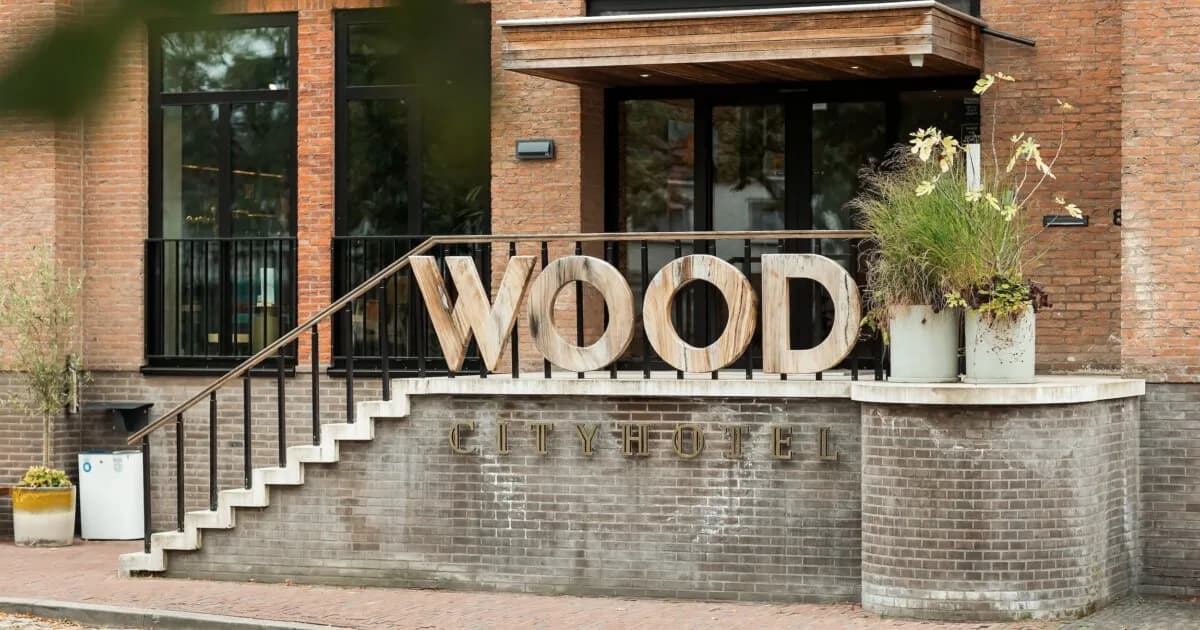
Cityhotel Wood opened in spring 2020 in a fully renovated building on Achter de Houttuinen, in the historic centre of Middelburg. The boutique eco-hotel started out with around fifty individually designed rooms and a strong focus on sustainability.
Bennie and Eva van de Parel run the hotel day to day. Owner Peter Bommeljé oversees the wider Zeayou Zeeland group, with hotels, apartments and B&Bs across Domburg, Middelburg and Zoutelande.
The hotel has grown steadily since its opening. When the chance came to acquire the former police station next door, Bommeljé took it.
Construction started in February. The conversion runs in two phases that take the hotel from 50 rooms to 100, with the second phase adding facilities such as a wellness area and a fitness centre.
Powering that growth was another matter. Both the existing hotel and the former police station needed electricity, and the regional grid was already under pressure. A straightforward connection upgrade was off the table.
Temporary measures, from extra storage to on-site generation with batteries and generators, covered part of the gap. But they were never going to be enough for a hotel twice the size. The hotel joined the grid operator's waiting list for extra capacity on both buildings.
Working every angle
COMCAM took the problem on. Working alongside the hotel and its installer, the team set out to keep the expansion on track while the capacity request was pending. Not with a standard playbook, but with a solution built around this specific case.
To do that, COMCAM drew on in-depth knowledge of how grid capacity, contracts and regulation fit together. It also brought a broad network, including contacts at the grid operator, and years of experience with exactly these situations across the energy industry. Three moves stood out.
One connection instead of two
Technically, the hotel and the former police station were two separate properties, each with its own contracted capacity. COMCAM proposed formally merging them into a single connection, with the municipality's cooperation. Treated as one installation, the hotel could draw on both buildings' capacity together, instead of being held back by whichever connection ran out of room first.
It was one of the moves that made the biggest difference, giving Cityhotel Wood significantly more headroom straight away.
A year of data, hour by hour
To pin down exactly how much more capacity was needed, COMCAM analysed a full year of the hotel's energy use, hour by hour. The strain on the connection turned out not to be constant. It came in sharp peaks around Christmas and New Year's Eve, when the hotel is fully booked and everything runs at once.
At night, by contrast, plenty of capacity sat unused.
A plan B, ready to go
That gap led COMCAM to model a battery solution. Charge it overnight, when demand is low, and draw on it during the handful of peak evenings a year instead of pulling more from the grid. COMCAM also looked at whether a different type of grid contract, offering extra capacity at night, could help charge the battery faster.
The advice was concrete enough to act on: based on it, the hotel ordered a battery ahead of the summer. Instead of an open-ended wait, Cityhotel Wood had a plan built on its own data.
One letter, many conversations
Then the news arrived. “Until four weeks ago, we were completely convinced we'd need to set up a complicated configuration,” says Bommeljé. “In the end, four weeks ago we received a letter from the grid operator: the full additional capacity we'd requested had been granted. That was good news.”
In fact, the hotel was granted more than it needs. “The situation now at Cityhotel Wood is that we've been granted overcapacity, so in the second phase too we have 100% sufficient energy. That's actually been solved properly in one go.”
A number of temporary measures could be rolled back. Measured against COMCAM's analysis, the granted capacity was far more than the hotel required, so the battery turned out not to be needed at this location after all.
From the hotel's side, it arrived as one welcome letter. Behind it were many conversations, as there usually are when a capacity request like this is resolved.
Along the way, the merged connection had given the hotel extra headroom, and the battery plan had given it a worked-out alternative. That is what working every angle looks like in practice: keeping an expansion on track while the outcome is still uncertain.
Domburg: €13,000 refunded, roughly €2,500 saved every year
At Hotel Bommeljé in Domburg, part of an apartment complex within the Zeayou Zeeland group, the same approach delivered hard savings. As the building expanded, its existing connection could no longer keep up, so the hotel paid more than €13,000 for a grid reinforcement. Months went by without progress on the work itself.
When COMCAM got involved, the job turned out to be far bigger than it looked. The grid operator's own voltage requirements meant replacing not just the final stretch to the building, but the entire supply cable to the property and much of the surrounding street.
COMCAM worked it through with the grid operator. It took persistence, but it led to a better outcome for everyone. Instead of the reinforcement, Hotel Bommeljé is installing a battery that covers its evening peaks using capacity it already has at night: the same principle COMCAM modelled for Cityhotel Wood.
The results are tangible. The reinforcement is no longer needed, and the €13,000 already paid for it has been refunded. The hotel also saves roughly €2,500 a year in standing charges.
The grid operator, meanwhile, avoids what COMCAM estimates could have been a six-figure infrastructure investment in the street. That saving ultimately benefits the wider public.
None of this happened by itself. Grid operator processes and requirements took more time and back-and-forth than expected, and untangling them called for the specialist, day-to-day industry knowledge that most businesses don't have in-house. Taking exactly that complexity off a company's plate is what COMCAM is there for.
From afterthought to scarce resource
COMCAM has been Cityhotel Wood's energy partner since the hotel opened, and the ties with Zeayou Zeeland go back further. Several of the group's other hotels have worked with COMCAM for more than ten years. That continuity is proving its value now that energy has become an ever-bigger item on the agenda.
“In the past you didn't think about it much: water, gas and electricity were just quickly connected. Now it's become a kind of scarce resource,” says Bommeljé. In his view, hotels have only had to respond to grid congestion over the past three or four years, which has driven extra attention to the sustainability of buildings and their installations.
For large buildings with substantial installations, that means thinking sharply about efficiency towards the grid operator. A single overshoot is one thing; structural overshoots cause real problems.
That is why buildings need to get smarter and flatten their peaks. “We're really only just getting started with that,” says Bommeljé.
The same questions play out across the group. For a new-build hotel, the electricity connection was arranged early and is sufficient. There, too, the installer determines the required capacity, after which COMCAM is consulted on how to request it from the grid operator.
At another hotel in the group, which regularly runs against its maximum capacity, the next step is for COMCAM and the group to look together at a solution with battery storage and solar power.
It isn't their trade. It's COMCAM's.
Bommeljé sees the full-service energy provider in the future. For hotels that don't consider energy their core business, it takes the worry off their hands.
“I've experienced the collaboration very positively,” he says. “I can imagine that businesses simply want that worry taken off their hands, because it isn't their trade; it's COMCAM's, so it makes sense that they're the ones solving it.”

Is grid capacity holding back your plans? Get in touch with COMCAM to explore every angle.


Recognise this situation?
Every energy situation is different. Our specialists will tell you honestly what is achievable for your organisation. Without obligation.
Related cases
Knowledge and smart energy management made all the difference for ‘t Zusje Terneuzen during the crisis
Where energy had previously been just an expense, it suddenly became a source of…
Read case
Care organization Amarant wants to become CO2-neutral
Amarant Care Organization is taking serious steps toward making its energy supply more sustainable.
Read caseLet's shape your energy future
Whether you're navigating market volatility, optimising your portfolio, or exploring sustainable solutions - we're here to help.
Read our whitepapers
In-depth publications on energy procurement, grid congestion and flexibility, written by our specialists. Free to download.
View whitepapersRead the latest market analysis
Power, gas, oil, coal, emissions and renewables, regularly analysed by our traders. The same intelligence our portfolio decisions are built on.
View market updates