IEA: The world is not going to meet tripling renewable energy by 2030.
“This is not quite sufficient to reach the goal of tripling renewable energy capacity worldwide established by nearly 200 countries at the COP28 climate summit.” – IEA

Despite the increase in renewable energy additions, the world is not yet on track to triple renewable capacity by 2030. This according to the Renewables 2024 report by International Energy Agency (IEA).
Global renewable capacity is expected to increase 2.7 times by 2030. That is more than the present national ambitions of appromixatley 25%. This while climate and energy security policies have boosted the attractiveness of renewables to make them cost-competitive with fossil fuels.
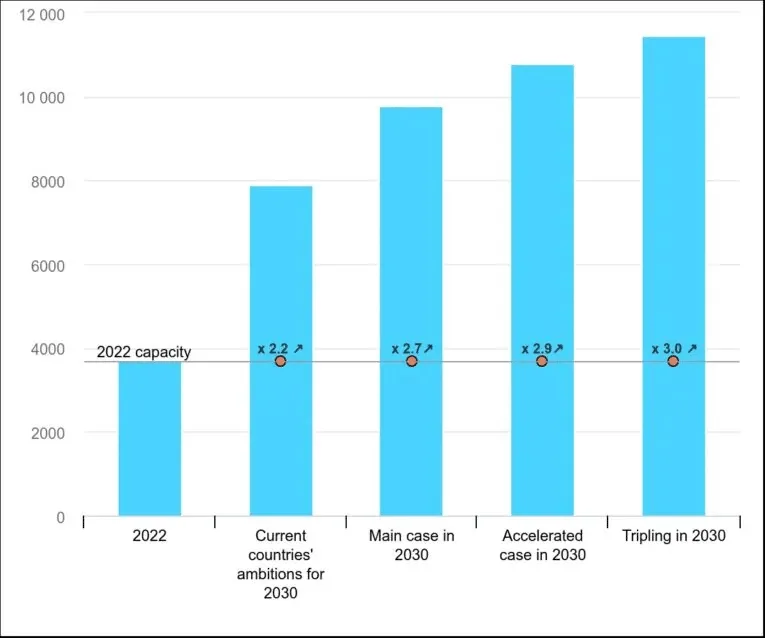
The agency’s base case, assuming existing policies and market conditions, forecasts 5,500 gigawatts (GW) of new renewable capacity operational by 2030. This means that global additions of renewable capacity will continue to grow each year. Nearly 940 GW per year will be reached by 2030. That is 70% more than the record level from 2023, according to the IEA.
Solar PV and wind are expected to account for 95% of all renewable capacity growth until the end of this decade. This is due to increasing economic attractiveness in almost all countries. As a result of these trends, nearly 70 countries, representing 80% of global renewable electricity capacity, are expected to meet or exceed their current renewable ambitions for 2030.
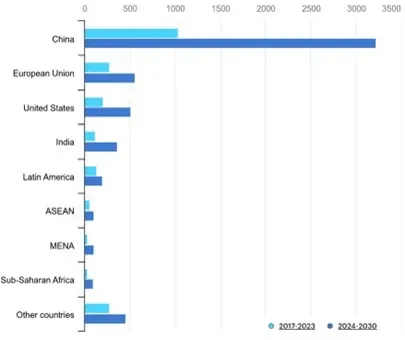
That is still less than the COP28 pledge of nearly 200 countries to triple renewable capacity. Growth is plentiful. However governments need to increase their efforts to integrate variable renewable sources, also called “wiggle power,” into electricity systems. The IEA also indicates that the rate of curtailment of renewable electricity generation recently has risen substantially . This curtailment is already 10% in several countries.
Previously, IEA reported that the global goal of tripling renewable energy capacity by the end of the decade is still within reach. However, this will require huge investments in power grids and energy storage.