Supertanker fares shoot up as war threatens Strait of Hormuz nadel eye
“Military action in the Middle East will likely take VLCC rates to levels not seen since 2019.” – Anoop Singh, Oil Brokerage Ltd. analyst

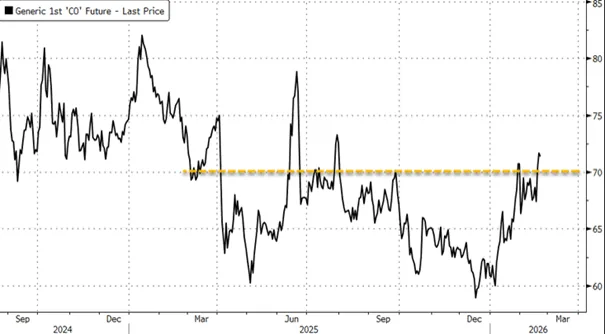
Brent crude futures rose to the highest level in six months by the end of the week, with prices above $71 a barrel (charts here) . President Trump said Tehran has 10 to 15 days to strike a deal with Washington on its nuclear program while the U.S. assembles forces across the Middle East. As the risk of war increases, the cost of chartering a supertanker is skyrocketing.
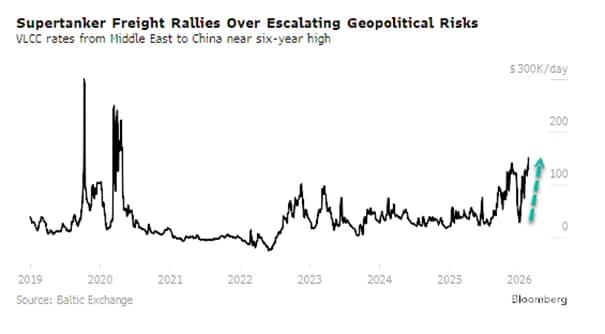
Bloomberg cites VLCC revenue data from the Baltic Exchange showing that fares on the Middle East-to-China route tripled this year to about $151,208 per day, the highest level since 2020.
Traders are hyper-focused on the potential disruption of the crucial maritime bottleneck the Strait of Hormuz, which may further drive up risk premiums for charters. Scarcity is also exacerbated by ownership concentration.
“Military action in the Middle East will likely take VLCC rates to levels not seen since 2019,” said Oil Brokerage Ltd. analyst Anoop Singh.
Tension in the oil market is mounting, especially toward the weekend, after President Trump said Tehran has about 10 to 15 days to make a deal on its nuclear program .10 to 15 days to make a deal
“We’re either going to get a deal, or it’s going to be unfortunate for them,” Trump told reporters aboard Air Force One on Thursday.
About the deadline, Trump said he thought 10 to 15 days was “pretty much” the “maximum” he would allow for the negotiation period. “I would think that would be enough time,” he said.
Bloomberg noted that the military power the U.S. is building in the region is the largest since 2003, adding, “It dwarfs the military buildup that Trump ordered off the coast of Venezuela in the weeks before he ousted President Nicolas Maduro.”
Bryan Clark, defense analyst at the Hudson Institute and former Navy strategy officer, told the Medium, “With Iran’s air defenses largely neutralized by previous US and Israeli strikes, the US strike fighters would operate largely with impunity over Iranian airspace.”
“There is always the risk of downed pilots, but I think the bigger risk is to ships. The same cruise and ballistic missiles the Iranians gave to the Houthis could be turned against US ships in the Persian Gulf, Arabian Sea, and Red Sea,” Clark said.
Kenneth Hvid, CEO of Teekay Tankers, recently told investors that the combination of consolidation in the VLCC segment and possible war risks in the Middle East means the movement in tanker rates is “more in anticipation of something happening,” adding, “It’s just a situation we need to watch.”